Blogware v1.2 New Ent Improv-Ed
Yeah - Its been quiet here.
We shipped v1.2 today. Probably the biggest single revision that we've ever done to the Blogware code base.
 In my mind, this is the v1.0 that we *should* have shipped. Users syndicating with RSS 2.0 now get to drop ENT metadata into their feeds - the UI has been cleaned up a *ton* (I've started calling it "the useful version" - Useful Interface instead of User Interface? Hmmm...sounds like a whole different post unto itself) and we've nailed down user profiles pretty substantially as well - check me out here.
The feature I'm most proud of? The new picture posting tools in the Rich Text Editor. I've hated how we had implemented this in the past and I hated seeing users struggle with simple things like uploading thumbnails - hopefully the new tools make this a lot easier to deal with.
There are a ton of new things in there - hopefully you have some fun uncovering them. Here's a checklist for those playing along at home:
- Added "Post Web Page" function. Allows custom static HTML web pages to be inserted in the standard templates and managed within Blogware.
- Added Reseller client OCS. Generates an OCS directory listing the weblogs belonging to the resellers clientele. Available via the Reseller Control Panel.
- Added Reseller client data export. Provides resellers with a CSV export of the contact information for their specific slients. This is available via the Reseller Control Panel.
- Added function to allow the forced deletion of a blog which is in "Pending Delete" state.
- Added function to automatically rename photographs when duplicate name is used. This is to facilitate the upload of images from phone-cams that recycle image file names.
- Added function to support secure file attachments to article entries.
- Added a tool that records a history of IP addresses of the individuals who are logging into a weblog via the Publisher Control Panel.
- Added support for article keywords.
- Added support to allow search of article keywords.
- Added "About Me" business card web page that includes image, contact information and social networking features (including FOAF, authenticated login, etc.) The About Me page is generated on the fly on located at a "personal permalink" in the form of "http://www.blogware.com/profiles/username/". Authenticated users will be provided with access to personal information as defined in the users "Address Book". This URL may be "cloaked" by the reseller.
- Added FOAF support. FOAF is generated and located at a similar permalink in the form of "http://www.blogware.com/users/profiles/username/foaf.rdf". Authenticated users will be provided with access to FOAF information as defined in the FOAF owners's "Address Book". Users can authenticate themselves by passing their Reader username and password via HTTP in the form of "http://username:password@www.blogware.com/users/profiles/username/foaf.rdf". This URL may be "cloaked" by the reseller.
- Added support to respect reseller private label variables for users that are navigating between the Publisher Control Panel and the Reader Control Panel.
- Added support to allow resellers to be mapped as parents of other resellers. Child resellers will not receive system updates/notices sent from Tucows. Parent resellers will be billed for the activity of their child resellers. This feature can be enabled by your account manager.
- Added additional user interface cues and streamlined interface to make the transition between the Publisher Control Panel to the Reader Control panel interfaces easier.
- Added support to allow Review templates to be fully customized.
- Added ENT (Easy News Topics) support for RSS 2.0 (Details regarding the ENT specification can be found at http://matt.blogs.it/specs/ENT/1.0/).
- Added support to enhance switching between the Rich Text Editor and the Standard Text Editor. Line breaks are now preserved.
- Added createBlogAdminCookie to the Blogware Reseller Provisioning API to facilitate "single sign-on" sessions from a Reseller hosted control panel into the Blogware control panel. See Blogware Provisioning API documentation for full details - http://resellers.blogware.com/bpa/
- Added addBlogCategories function to Blogware Reseller Provisioning API to facilitate the creation and addition of customized categories to newly created weblogs. See Blogware Provisioning API documentation for full details - http://resellers.blogware.com/bpa/
- Added additional reseller branding support on the user login page into the Publisher Control Panel.
- Added support to allow Resellers to specify Layout & Component defaults that are applied to weblogs they provision via the API or Reseller Control Panel.
- Added support to allow Resellers to create and designate default favorites list and its contents
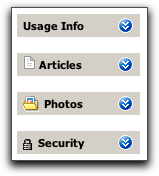
- Added "New User" cues to the Publisher Control Panel interface and streamlined navigation including the capability to show and hide less/more commonly used interface elements via a "roll-up" widget. This also includes signficant changes to the "Settings" tab which now breaks various settings into more logical and distinct groups of settings related functions.
- Added support for RSD, "Really Simple Discoverability", 1.0. RSD is a mechanism that helps client software find the services needed to read, edit, or "work with" Blogware. Full details concerning the RSD 1.0 specification can be found at http://archipelago.phrasewise.com/rsd
- Added support to make it easier to insert images in an Article entry within the Rich Text Editor.
- Added support to export "author" information within the Blogware export file.
- Added UTC support in blog xml-rpc interface and fixed various TIME formatting issues.
- Removed "article widgets".
See this post as it first appeared on Blogware.
12 comments
Comments are closed - these are kept exactly as they were left.
(name not saved), September 21, 2004
Looking forward to seeing it/using it. Looks like you've been busy !
And us to ... have you by any chance had an opportunity to take a look at the official beta version of Qumana, released on Sept. 16th ? Works really really well with Blogware ... and is now fundamentally different, and more effective than the previous ThoughtShare app upon which Q is based.
(name not saved), September 21, 2004
"Added support to export "author" information within the Blogware export file."
/me gets a kleenex and cries the sobs of pain and sorrow...
It's not in there :-( Exports are exactly the same. Evil export tease!!!
(name not saved), September 21, 2004
I wish that support for importing author info when importing from MT would also be added. Great update though.
(name not saved), September 21, 2004
muhahahaha.
No seriously, that was actually one of two features that got backed up behind a commit that slipped. I had a conversation with Tom no less than an hour ago and specifically said "Okay, you can let one of them slip, but make sure you deal with the author support feature in the export because Jason is really looking for this and he's a cool guy and live close enough to you to kick your ass." and he said "okay fer sure!"
Or something like that. So - look for it - like today. And if you don't see it, get on up to Thousand Oaks and pay Mr. Tom a visit.
(name not saved), September 21, 2004
Oh that's right! I know where he lives! Where are my car keys???
:-) Thanks man...
(name not saved), September 21, 2004
The last thing I want is an angry geek breaking down my door. I think you're all set, give it a whirl.
(name not saved), September 21, 2004
On the FOAF stuff. I see you are exposing the mbox for all contacts. This is Not a Good Thing(tm). Should be showing mbox_sha1sum.
Also, there doesn't seem to be very much information in there. Are you supporting the full set of FOAFnet values?
(name not saved), September 22, 2004
Good catch - fixed. But we're not using the hash (which would bring us into conformance with the minimal foafnet spec). Instead, we're relying on the Blogware auth model to determine whether or not the requester can be trusted and if so, at what level. This is all set by the owner of the data in their address book so that different people and classes of users see different data in the FOAF. By default, we assume that unauthed users shouldn't get anything - but this can be changed by a particular user in their address book.
Does this make sense?
(name not saved), September 22, 2004
It does make sense, except in the case where I (as someone as a Blogware profile) want to share/sync my FOAF profile with external entities. So, has to be some way to programmatically authenticate.
And of course, conformance to the spec (use the hash!) would be nice as standardized solutions come on line.
(name not saved), September 22, 2004
You can programmaticly authenticate using http-auth.
Let's say you want to export your FOAF from your Blogware profile to Plaxo.
(Okay, now stop laughing.)
Assuming Plaxo has a Blogware reader account, all you need to do is grant them permission to read the elements that you want to export and then have them grab the auth'ed information. I know - not standardized.
Marc will, of course, kill me because of this but I'm rather stuck as to how we can implement a spec that goes directly against the model that we use for everything else...if anyone has any thoughts here, I'd be more than happy to entertain them.
(name not saved), September 22, 2004
/stops laughing
Yes, Marc will kill you :p
Actually, http-auth might be good enough, but it will require putting your Blogware details into a potentially untrusted third-party system. And this of course assumes pre-knowledge of the external sources that might want access (e.g. Plaxo, SystemX, SystemY).
I have some code that can test this, so I'll start there and give some more specific feedback about potential changes.
(name not saved), September 22, 2004
They would use their own credentials to auth and retrieve the data, not yours. All you need to do is tell Blogware that you trust their credentials...
(i.e. Boris trusts Plaxo with his email address, home ph # but not his web site address).